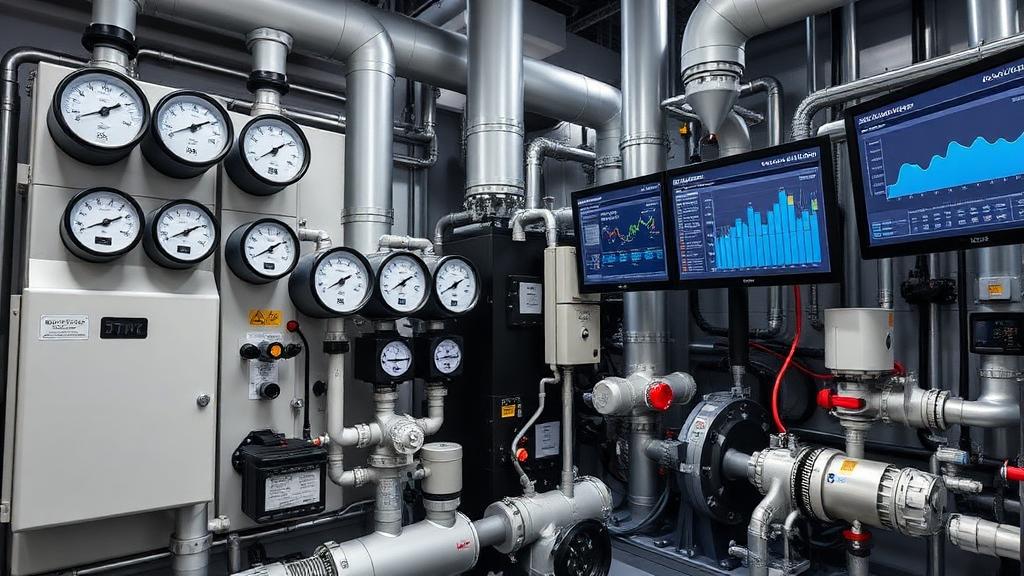
Central plant operations — chiller plants, boiler systems, compressed air networks, and steam distribution — represent some of the largest and most complex energy consumers in municipal and institutional facilities. Yet many facility operators lack the granular measurement data needed to understand where energy is being consumed, how efficiently systems are operating, and where opportunities exist for cost reduction. Energy submetering provides the visibility that transforms central plant management from educated guessing to data-driven optimization.
The Measurement Gap in Central Plant Operations
Most facilities receive a single utility bill that aggregates all energy consumption into one number. This aggregate view tells operators how much energy they used last month, but reveals nothing about which systems consumed that energy, how efficiently those systems operated, or where waste occurred. It's the equivalent of managing a household budget with only a total bank statement — you know money was spent, but you can't identify where savings are possible.
Energy submetering closes this gap by measuring consumption at the system, equipment, and circuit level. BTU meters on chiller and hot water loops quantify thermal energy production and distribution losses. Power meters on major equipment track electrical consumption relative to output. Steam and compressed air meters identify distribution losses and end-use consumption patterns. Together, these measurements create a complete energy picture that enables informed decision-making.
BTU Metering for Chiller Plant Optimization
Chiller plants typically represent the single largest energy consumer in commercial and institutional facilities, accounting for 30-50% of total electrical consumption during cooling season. BTU metering quantifies the relationship between electrical input (kW) and cooling output (tons), providing the real-time efficiency metric — kW per ton — that drives optimization decisions.
Individual chiller BTU metering reveals performance differences between chillers in a multi-chiller plant, enabling staging strategies that load the most efficient chillers first. It also detects gradual efficiency degradation from condenser fouling, refrigerant charge loss, or compressor wear — problems that increase energy consumption by 10-30% if left unaddressed.
Distribution system BTU metering identifies thermal losses in piping networks and quantifies cooling delivered to individual buildings or zones. This data supports accurate cost allocation in multi-tenant facilities and identifies distribution system improvements — such as insulation upgrades or valve repairs — that reduce losses and improve system capacity.
Emergent Energy's BTU metering solutions use precision flow meters and matched temperature sensors to achieve ±2% thermal energy measurement accuracy, providing the reliable data foundation needed for both operational optimization and equitable cost allocation.
Steam System Submetering
Steam distribution systems present unique metering challenges due to varying pressure, temperature, and quality conditions throughout the distribution network. Vortex shedding, differential pressure, and Coriolis flow meters each offer advantages for specific steam applications, and proper meter selection requires understanding of process conditions, required accuracy, and maintenance capabilities.
Steam system submetering typically focuses on three objectives: production efficiency monitoring, distribution loss identification, and end-use consumption measurement. Boiler efficiency monitoring compares fuel input (measured by gas meters) with steam output (measured by steam flow meters), revealing efficiency trends and identifying maintenance needs. Distribution loss measurement compares total steam production with the sum of end-use consumption, quantifying the energy — and cost — lost to leaks, failed traps, and inadequate insulation.
End-use steam metering enables accurate cost allocation and identifies process-level optimization opportunities. In facilities where steam is used for heating, humidification, sterilization, kitchen operations, and laundry, submetering reveals the consumption patterns that drive operating costs and provides the baseline for evaluating efficiency improvements.
Compressed Air Metering
Compressed air is often called the "fourth utility" — and the most expensive one. Producing compressed air costs 7-10 times more per unit of energy delivered than electricity, making compressed air system efficiency a high-value optimization target. Yet many facilities operate compressed air systems without any measurement beyond compressor runtime hours and discharge pressure.
Compressed air submetering quantifies system-level metrics including total production volume, specific power (kW per 100 CFM), and system pressure profile. These measurements reveal compressor loading efficiency, identify inappropriate use of compressed air (such as cooling or blow-off applications where lower-cost alternatives exist), and detect distribution system leaks that waste 20-30% of compressed air production in many facilities.
KW Metering's compressed air measurement solutions provide the flow, pressure, and power data needed to benchmark compressed air system performance and validate the savings from system improvements including leak repair, pressure optimization, compressor sequencing, and demand-side management.
Gas and Utility Submetering
Natural gas submetering applies the same principles of granular measurement to gas-fired equipment including boilers, water heaters, kitchen equipment, and laboratory systems. Gas submetering data supports efficiency monitoring of individual equipment, accurate cost allocation to building occupants or departments, and verification of utility billing accuracy.
For facilities with cogeneration or combined heat and power (CHP) systems, comprehensive gas and electrical submetering provides the performance data needed to optimize system dispatch, verify contractual performance guarantees, and document environmental benefits for sustainability reporting.
Multi-utility submetering — covering electricity, gas, water, steam, chilled water, and compressed air — provides the complete energy picture needed for comprehensive facility benchmarking. Emergent Energy integrates all utility measurements into unified cloud dashboards that present energy data in operational context, enabling facility managers to identify optimization opportunities across all energy systems.
Cloud Analytics and Real-Time Dashboards
Raw metering data has limited value without analytics that transform measurements into actionable intelligence. Cloud-based analytics platforms provide continuous access to energy performance data through customizable dashboards, automated reports, and alert notifications that keep facility managers informed without requiring constant manual monitoring.
Effective energy dashboards present key performance indicators (KPIs) for each major system — chiller plant kW/ton, boiler efficiency percentage, compressed air specific power, steam system distribution efficiency — alongside consumption trends, cost data, and comparison benchmarks. Automated anomaly detection identifies unusual consumption patterns that may indicate equipment malfunction, control system errors, or operational changes that increase energy use.
Open-protocol integration — Modbus, BACnet, OPC-UA — connects metering instrumentation to existing building management systems (BMS) without requiring replacement of working infrastructure. This integration approach respects existing system investments while adding the analytical capability needed for energy optimization.
Cost Allocation and Tenant Billing
In multi-tenant facilities, accurate energy cost allocation requires submetering that captures each tenant's consumption of electricity, heating, cooling, and other utilities. Submetering-based billing replaces estimated allocations — typically based on square footage — with actual consumption data, creating financial incentives for tenants to conserve energy and eliminating disputes over billing accuracy.
Submetering for cost allocation must meet applicable regulatory requirements for billing accuracy, which vary by jurisdiction. Emergent Energy specifies and installs revenue-grade metering that meets ANSI C12 accuracy standards for electrical metering and AHRI certification requirements for thermal energy metering, ensuring that billing data withstands regulatory scrutiny and tenant challenges.
SCADA and BMS Integration
Central plant submetering data becomes most valuable when integrated with SCADA or BMS platforms that control plant equipment. Integration enables automated responses to metering data — adjusting chiller staging based on real-time efficiency measurements, modulating boiler firing rates based on steam demand, or sequencing compressors based on air demand profiles.
The integration architecture must support the communication protocols used by existing control systems. Most modern metering instruments support multiple protocols — Modbus RTU, Modbus TCP, BACnet IP, BACnet MSTP — enabling direct connection to any SCADA or BMS platform. For facilities with older control systems, protocol converters and gateways bridge communication gaps without requiring control system replacement.
Standards and Calibration
Energy metering accuracy depends on proper instrument selection, installation, and ongoing calibration. NIST-traceable calibration procedures with documented uncertainty budgets ensure that metering data meets accuracy requirements for both operational optimization and financial billing. Calibration intervals follow manufacturer recommendations, typically 12-24 months for most metering instruments, with interim verification checks that detect drift between scheduled calibrations.
Conclusion
Central plant energy submetering transforms facility operations from aggregate cost management to granular performance optimization. By measuring energy production, distribution, and consumption at the system and equipment level, facility operators gain the visibility needed to reduce waste, optimize equipment performance, allocate costs accurately, and document the impact of efficiency improvements. Emergent Energy provides complete submetering solutions — from instrument specification through cloud analytics — that deliver the measurement intelligence modern facilities demand. Contact us at 215-645-7141 or visit emergentenergy.us to discuss your submetering needs.