Introduction
In multi-tenant commercial properties—office buildings, shopping centers, industrial parks, and mixed-use developments—the allocation of utility costs among tenants is a perennial challenge. Traditional allocation methods based on square footage or fixed percentages bear little relationship to actual consumption, creating inequities that generate tenant complaints, discourage conservation, and complicate property management.
Submetering—the installation of dedicated meters for individual tenants, floors, or zones—provides a direct, transparent basis for utility cost allocation that addresses these problems. By measuring actual consumption, submetering enables fair billing, creates conservation incentives, and provides the data needed for energy management and sustainability reporting.
The Limitations of Traditional Cost Allocation
Traditional methods for allocating utility costs among tenants typically rely on proportional shares based on leased area. While simple to administer, this approach has several significant drawbacks that affect both landlords and tenants.
First, area-based allocation does not reflect actual consumption. A tenant operating data centers or laboratories may consume several times more energy per square foot than a standard office tenant, yet under area-based allocation, both tenants pay the same rate per square foot. This effectively subsidizes high-consumption tenants at the expense of low-consumption tenants.
Second, area-based allocation provides no incentive for conservation. Since individual tenants do not see the impact of their consumption on their costs, they have no financial motivation to reduce waste. Studies consistently show that the introduction of consumption-based billing reduces energy use by ten to twenty percent, even without other conservation measures.
Third, area-based allocation can create disputes during lease negotiations and renewals. Tenants who believe they are subsidizing other tenants' consumption may demand lower base rents or concessions to offset perceived inequities. These disputes can strain landlord-tenant relationships and complicate property management.
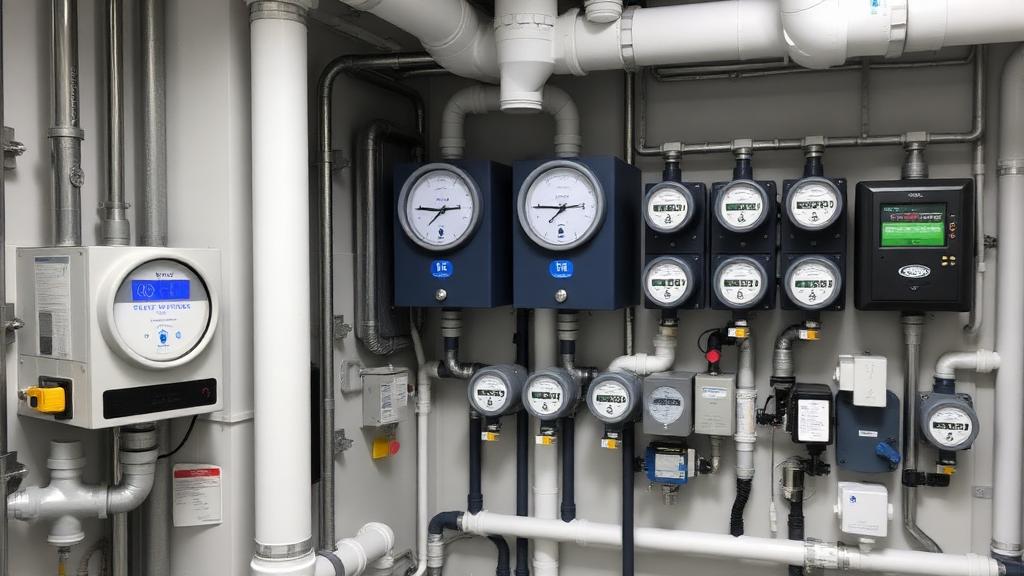
Submetering Technologies for Commercial Properties
Several metering technologies are available for commercial property submetering, each suited to different utility types and installation conditions.
Electrical submetering is the most common form of tenant metering. Modern solid-state electrical meters provide accurate measurement of energy consumption (kWh), demand (kW), power factor, and other electrical parameters. Split-core current transformers enable installation without disconnecting existing wiring, simplifying retrofit installations.
Revenue-grade electrical meters must meet ANSI C12 standards for accuracy and be certified by the appropriate regulatory authority. While utility-grade meters are not required for submetering in most jurisdictions, using certified meters provides credibility and defensibility for the billing program.
Water submetering uses in-line flow meters to measure water consumption by individual tenants or floors. Electromagnetic, ultrasonic, and positive displacement meters are all suitable for this application, with the choice depending on pipe size, flow range, and accuracy requirements. Remote-reading capability is essential for efficient data collection in buildings with meters distributed across multiple floors and locations.
Thermal energy (BTU) metering is used for allocating heating and cooling costs when central plant systems serve multiple tenants. As discussed in previous articles, BTU meters combine flow measurement with temperature differential measurement to calculate thermal energy consumption. Proper installation and calibration are critical for accurate measurement.
Gas submetering is less common than electrical or water submetering but is used in properties where individual tenants have dedicated gas-consuming equipment such as kitchens, laboratories, or dedicated HVAC systems. Diaphragm, rotary, and turbine meters are used depending on the flow rate range and accuracy requirements.
Automatic Meter Reading and Data Management
The practical success of a submetering program depends heavily on the efficiency and reliability of data collection and management. Manual meter reading is labor-intensive, error-prone, and impractical for buildings with large numbers of meters. Automatic meter reading (AMR) and advanced metering infrastructure (AMI) systems automate data collection and provide the foundation for efficient billing and analytics.
Wired AMR systems use building communication networks—such as RS-485 serial networks, Ethernet, or dedicated metering networks—to collect data from meters. These systems provide reliable, high-frequency data collection and are well-suited for new construction where communication wiring can be included in the building design.
Wireless AMR systems use radio frequency communication to collect meter data without dedicated wiring. Technologies such as Zigbee, LoRaWAN, and proprietary radio protocols provide reliable wireless communication within buildings at reasonable cost. Wireless systems are particularly attractive for retrofit installations where running new communication wiring would be disruptive and expensive.
Cloud-based metering platforms provide data storage, analysis, and billing functionality as a service. These platforms collect data from meters through building-level gateways, process it in the cloud, and provide web-based interfaces for data visualization, report generation, and billing management. Cloud platforms offer scalability, automatic software updates, and reduced on-site infrastructure requirements.
Billing Structures and Rate Design
The design of the billing structure for submetered utilities should reflect the actual cost structure of the utility service while remaining transparent and easy for tenants to understand. Several billing approaches are commonly used.
Straight consumption billing charges tenants based solely on measured consumption, typically at a rate that reflects the blended cost of the utility. This approach is simple and transparent but may not fully recover fixed costs during periods of low consumption.
Two-part billing separates utility costs into a fixed demand charge and a variable consumption charge. The demand charge, based on peak consumption during the billing period, reflects the capacity-related costs of the utility system. The consumption charge reflects the variable costs associated with actual energy or water use. This structure more accurately reflects the utility cost structure and provides incentives for both conservation and peak demand reduction.
Time-of-use billing applies different rates during peak, off-peak, and shoulder periods to reflect the time-varying cost of electricity from the grid. This approach passes through the utility's rate structure to tenants, creating incentives for shifting consumption to lower-cost periods. Implementing time-of-use billing requires meters capable of recording consumption by time period.
Legal and Regulatory Considerations
The legal framework for utility submetering varies by jurisdiction and can significantly affect program design and implementation. Some states regulate submetering as a utility activity, imposing requirements for rate structures, meter accuracy, billing practices, and consumer protection. Other states have minimal regulation, allowing property owners considerable flexibility in designing their submetering programs.
Lease language is critical for establishing the legal framework for submetered billing. Leases should clearly describe the submetering arrangement, the billing methodology, the rate structure, and the dispute resolution process. Including submetering provisions in initial lease negotiations is far easier than attempting to retrofit them into existing leases.
Building codes and standards may affect the physical installation of submetering equipment. Electrical codes, plumbing codes, and fire codes all have provisions that may apply to the installation of meters and associated equipment. Compliance with applicable codes and standards should be verified during the design phase and documented during installation.
Implementation Strategy
A successful submetering implementation requires careful planning that considers technical, financial, and organizational factors. Key steps include conducting a feasibility assessment, selecting metering technology and data management systems, designing the billing program, installing and commissioning meters, and communicating the program to tenants.
The feasibility assessment should evaluate the physical infrastructure of the building, including the distribution system layout, available space for meter installation, and existing communication infrastructure. It should also estimate the costs and benefits of submetering, including equipment costs, installation costs, ongoing data management costs, and projected savings from conservation.
Phased implementation may be appropriate for large properties or portfolios. Starting with a pilot program in a portion of the property allows the property management team to refine procedures and address issues before full-scale deployment.
Conclusion
Utility submetering is a proven strategy for achieving fair cost allocation, driving conservation, and improving property financial performance. Modern metering technology, automatic data collection, and cloud-based management platforms have made submetering more accessible and cost-effective than ever. Property owners and managers who implement submetering programs will benefit from reduced utility costs, fewer tenant disputes, and enhanced property value.