Introduction
The water and wastewater treatment industry has traditionally relied on two maintenance strategies: reactive maintenance, where equipment is repaired after it fails, and preventive maintenance, where equipment is serviced on a fixed schedule regardless of its actual condition. Both approaches have significant drawbacks. Reactive maintenance leads to unplanned downtime, emergency repairs, and potentially compromised treatment quality. Preventive maintenance avoids these problems but often results in unnecessary maintenance activities, replacing components that still have useful life remaining and consuming labor and materials that could be better deployed elsewhere.
Predictive maintenance represents a third approach that addresses the limitations of both reactive and preventive strategies. By continuously monitoring equipment condition using sensors and analyzing the data to predict when maintenance will be needed, predictive maintenance enables maintenance activities to be scheduled based on actual equipment condition rather than arbitrary time intervals or failure events.
The IoT Revolution in Water Treatment
The Internet of Things (IoT) has dramatically reduced the cost and complexity of deploying sensors for equipment monitoring. Modern IoT sensors are wireless, battery-powered, and self-configuring, enabling rapid deployment without the expense of running power and communication cables. Cloud-based analytics platforms process the sensor data and provide actionable insights through web-based dashboards and mobile applications.
The convergence of affordable sensors, ubiquitous wireless connectivity, and powerful cloud computing has made predictive maintenance accessible to facilities of all sizes. Where traditional condition monitoring systems required significant capital investment and specialized expertise, IoT-based systems can be deployed incrementally, starting with the most critical equipment and expanding over time.
Key Monitoring Technologies
Several sensing technologies are used in IoT-based predictive maintenance systems for water treatment equipment. Each technology provides specific information about equipment condition and potential failure modes.
Vibration monitoring is the cornerstone of predictive maintenance for rotating equipment such as pumps, blowers, and motors. Changes in vibration patterns can indicate bearing wear, imbalance, misalignment, looseness, and other mechanical problems. Modern vibration sensors can detect subtle changes in vibration signatures that precede failure by weeks or months, providing ample time for planned repairs.
Triaxial accelerometers measure vibration in three perpendicular axes simultaneously, providing comprehensive information about equipment dynamics. These sensors can capture vibration data across a wide frequency range, from low-frequency structural resonances to high-frequency bearing defect frequencies. IoT-enabled vibration sensors collect data at regular intervals and transmit it to the cloud for analysis.
Temperature monitoring provides complementary information to vibration analysis. Elevated temperatures in bearings, motor windings, or gearboxes can indicate friction, insulation breakdown, or cooling system problems. Infrared temperature sensors can monitor surface temperatures without contact, while embedded RTDs or thermocouples provide internal temperature measurements.
Current and power monitoring of electric motors can reveal developing mechanical and electrical problems. Changes in current draw, power factor, or current waveform can indicate issues such as bearing wear, impeller damage, winding insulation deterioration, or supply voltage problems. Motor current signature analysis (MCSA) uses advanced signal processing to extract diagnostic information from the motor current waveform.
Ultrasonic monitoring detects high-frequency sound emissions that are associated with friction, electrical discharge, and fluid turbulence. Ultrasonic sensors can detect bearing defects, compressed air leaks, electrical arcing, and valve leakage. The high-frequency nature of ultrasonic signals means they are highly directional, enabling precise identification of the source of emissions.
Oil analysis, while not strictly an IoT technology, can be integrated into a predictive maintenance program through automated sampling and online oil condition monitoring. Oil condition sensors can measure parameters such as viscosity, water content, particle count, and dielectric constant, providing continuous insight into lubricant condition and equipment wear.
Data Analytics and Machine Learning
The value of IoT sensor data is realized through analytics that transform raw measurements into actionable maintenance insights. Several analytical approaches are used in predictive maintenance systems.
Threshold-based alerts compare measured values against predefined limits and generate alerts when thresholds are exceeded. While simple, threshold-based alerts can miss gradually developing problems that stay below absolute thresholds, and they can generate false alarms during normal operating variations.
Trend analysis tracks the progression of measured values over time, identifying gradual changes that may indicate developing problems. By establishing baseline patterns and monitoring for deviations, trend analysis can detect slow degradation that threshold-based alerts would miss.
Machine learning algorithms can identify complex patterns in multi-sensor data that are not apparent from individual measurements. These algorithms learn normal equipment behavior from historical data and detect anomalies that deviate from expected patterns. As the algorithms are exposed to more data, including confirmed failure events, their predictive accuracy improves.
Digital twin technology creates virtual representations of physical equipment that can be used to simulate behavior and predict performance under various conditions. By comparing actual sensor data with digital twin predictions, deviations can be identified that indicate developing problems or suboptimal operating conditions.
Application to Water Treatment Equipment
Predictive maintenance principles can be applied to virtually all mechanical and electrical equipment in water treatment facilities. Several equipment categories offer particularly high value from predictive maintenance.
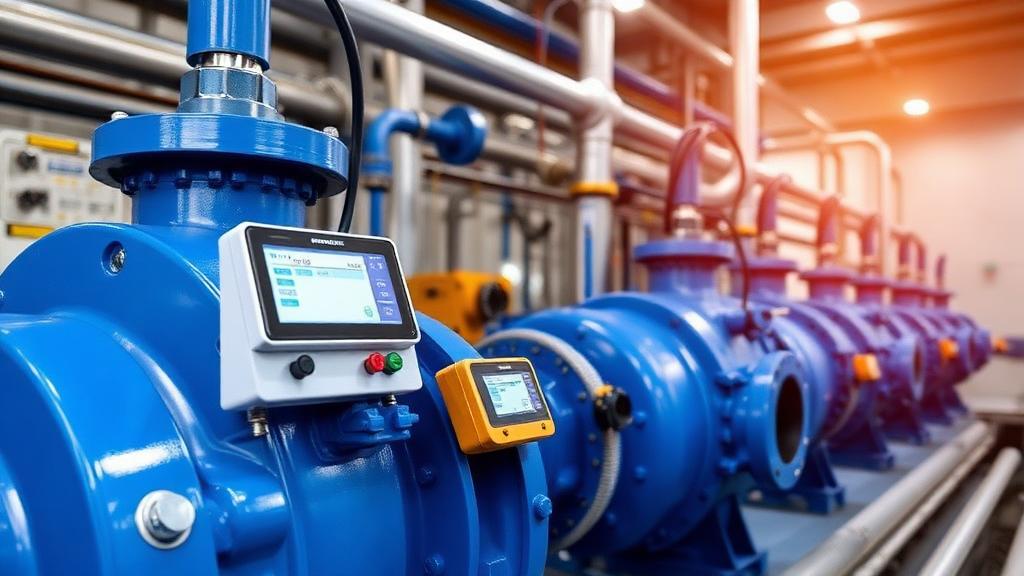
Pumps are the most common rotating equipment in water treatment facilities and account for a significant portion of maintenance costs and unplanned downtime. Vibration monitoring, temperature monitoring, and performance analysis (comparing actual flow and head with design curves) can detect bearing wear, impeller degradation, seal failures, and cavitation before they cause failures.
Blowers and compressors are critical equipment in activated sludge systems and other aeration applications. Vibration monitoring is particularly valuable for these high-speed machines, where bearing failures can progress rapidly. Temperature monitoring of bearings, oil, and discharge air provides additional diagnostic information.
Chemical feed systems, including metering pumps, chemical storage tanks, and piping systems, can benefit from monitoring that detects diaphragm degradation, check valve failure, and chemical depletion before these issues affect treatment performance.
Implementation Strategy
Successful implementation of an IoT-based predictive maintenance program requires a structured approach that considers equipment criticality, available resources, and organizational readiness.
A criticality assessment should be the first step, identifying the equipment whose failure would have the greatest impact on treatment operations, regulatory compliance, and costs. This assessment provides the basis for prioritizing sensor deployment and analytical development.
Pilot deployment on a small number of critical equipment items allows the maintenance team to develop experience with the technology and refine procedures before full-scale deployment. The pilot should include clear success criteria and a structured evaluation process.
Integration with the facility's computerized maintenance management system (CMMS) is essential for translating predictive insights into maintenance actions. Work orders generated from predictive alerts should include diagnostic information that helps maintenance technicians understand the nature and urgency of the recommended maintenance.
Training and change management are critical for successful adoption. Maintenance personnel must understand the capabilities and limitations of predictive maintenance technology and be comfortable incorporating predictive data into their decision-making processes. Leadership support and clear communication of program goals and benefits help build organizational commitment.
Measuring Program Value
The value of a predictive maintenance program can be measured through several key performance indicators. Equipment availability—the percentage of time equipment is available for operation—should increase as unplanned failures decrease. Mean time between failures should increase as developing problems are detected and corrected before they cause failures.
Maintenance costs should shift from a reactive profile, with high emergency repair costs and unplanned downtime, to a planned profile, with lower total costs and scheduled maintenance activities. The ratio of planned to unplanned maintenance is a useful indicator of program maturity.
Conclusion
IoT-based predictive maintenance is transforming equipment management in water and wastewater treatment facilities. By providing continuous visibility into equipment condition and enabling data-driven maintenance decisions, predictive maintenance reduces downtime, extends equipment life, and optimizes maintenance spending. As sensor technology continues to advance and analytics capabilities mature, the case for predictive maintenance will only grow stronger.