Introduction
Water distribution system pressure management is one of the most cost-effective strategies available to utilities for reducing infrastructure failures, minimizing water losses, and extending the useful life of aging pipe networks. The relationship between pressure and system performance is well-established: higher pressures accelerate pipe deterioration, increase leak flow rates, and stress joints and fittings, while lower pressures can compromise fire flow capacity and customer service.
Finding the optimal balance between these competing requirements requires a data-driven approach supported by comprehensive pressure monitoring instrumentation. Utilities that implement strategic pressure management programs consistently report significant reductions in main breaks, leak volumes, and non-revenue water, along with measurable improvements in infrastructure longevity.
The Physics of Pressure and Pipe Failure
Understanding the relationship between pressure and pipe failure is fundamental to developing an effective pressure management strategy. Pipe failures occur when the stress on a pipe exceeds its structural capacity. This stress is directly related to internal pressure, with the circumferential (hoop) stress in a pipe being proportional to the product of pressure and pipe diameter divided by wall thickness.
Pressure transients—sudden changes in pressure caused by pump starts and stops, valve operations, and demand variations—can generate peak pressures that far exceed steady-state operating pressures. These transients impose dynamic stresses that accelerate fatigue damage in pipe walls and can cause immediate failures in weakened pipes. Monitoring and mitigating pressure transients is an essential component of infrastructure protection.
The rate of leakage through pipe defects is also directly related to pressure. For a fixed defect size, the leak flow rate increases approximately in proportion to the square root of pressure. More importantly, many pipe materials exhibit pressure-dependent defect behavior, where higher pressures cause defects to expand, resulting in leak rates that increase faster than the square root relationship would predict.
Pressure Monitoring Instrumentation
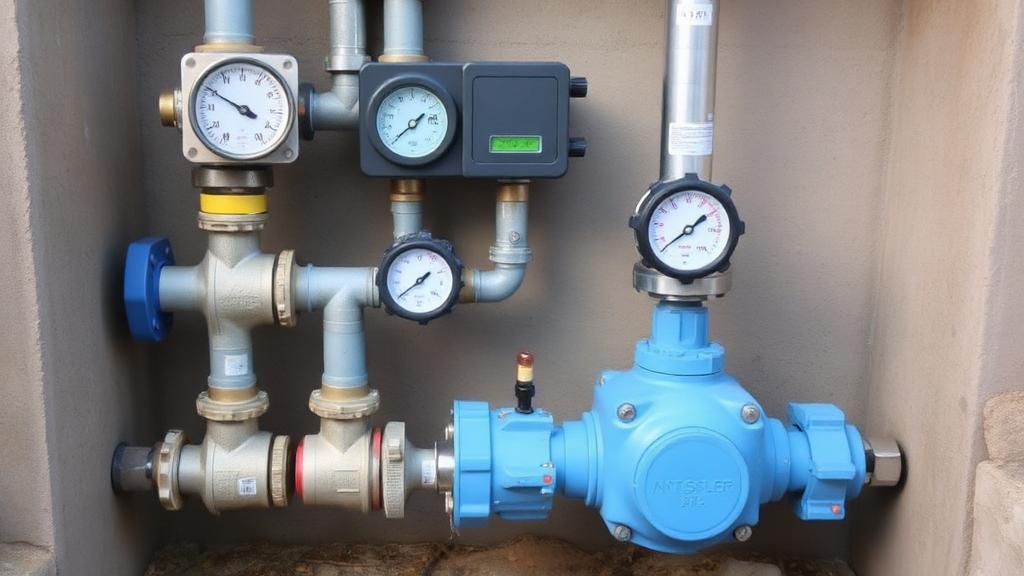
Effective pressure management requires continuous monitoring at strategic locations throughout the distribution system. Modern pressure monitoring instruments provide high-resolution data that supports both real-time operations and long-term analysis.
Permanently installed pressure transmitters provide continuous monitoring at fixed locations. These instruments typically use piezoresistive or capacitive sensing elements to measure gauge pressure, with typical accuracy of plus or minus 0.1 to 0.5 percent of full scale. They are powered by the SCADA system or by battery, with solar charging available for remote locations.
Data logging pressure recorders provide temporary monitoring capability for system studies and problem investigation. These battery-powered devices can record pressure at intervals as short as one second for periods of several weeks, providing detailed pressure profiles that reveal transient events and diurnal patterns.
High-speed pressure transient recorders are specialized instruments designed to capture the rapid pressure fluctuations that characterize transient events. These instruments sample at rates of hundreds or thousands of times per second, providing the temporal resolution needed to analyze the magnitude, duration, and frequency of pressure transients.
Strategic Placement of Pressure Monitors
The effectiveness of a pressure monitoring program depends on the selection and placement of monitoring points. The monitoring network should provide coverage of the full range of pressure conditions within the system, from the highest-pressure zones near pumping stations and elevated storage to the lowest-pressure zones at the hydraulic periphery.
Critical monitoring locations include pump station discharge, which provides data on pump performance and pressure delivered to the system; the maximum pressure point in each pressure zone, which is typically the lowest elevation point nearest the pressure source; the minimum pressure point in each zone, which is typically the highest elevation point farthest from the pressure source; and locations where pressure complaints or main breaks have been concentrated.
The number of monitoring points required depends on system size, complexity, and the specific objectives of the pressure management program. As a general guideline, a minimum of three to five permanent monitoring points per pressure zone provides adequate coverage for most management purposes.
Pressure Reducing Valve Systems
Pressure reducing valves (PRVs) are the primary tools for implementing pressure management in water distribution systems. Modern PRVs can be equipped with electronic controllers that enable sophisticated pressure management strategies.
Fixed outlet pressure control is the simplest PRV application, reducing downstream pressure to a constant setpoint regardless of upstream pressure or downstream demand. While effective, this approach may result in unnecessarily high pressures during low-demand periods when customer requirements are minimal.
Time-modulated pressure control adjusts the downstream pressure setpoint based on time of day. Lower pressures are maintained during nighttime hours when demand is minimal and higher pressures are provided during daytime hours when demand and fire flow requirements are greatest. This approach can significantly reduce average pressure while maintaining adequate service during peak periods.
Flow-modulated pressure control adjusts the downstream pressure setpoint based on measured downstream flow. As flow increases (indicating higher demand), the pressure setpoint is increased to maintain adequate pressure at the extremities of the zone. As flow decreases, the pressure setpoint is reduced. This approach provides the most responsive pressure management while ensuring that minimum service pressures are maintained at all times.
Critical point pressure management uses a remote pressure sensor at the most vulnerable point in the pressure zone to control the PRV setpoint. The PRV adjusts its output to maintain the required minimum pressure at the critical point, allowing pressure at other points in the zone to vary as needed. This approach ensures that the entire zone receives adequate pressure while minimizing average system pressure.
Transient Protection
Pressure transient management is an often-overlooked aspect of pressure management that can have a significant impact on infrastructure protection. Transient events can generate peak pressures two to three times higher than normal operating pressure, and the cyclic nature of these events accelerates fatigue damage in pipe walls.
Surge anticipation valves detect the onset of a pressure transient and open rapidly to dissipate the energy before it damages the system. These valves are typically installed at locations where transient events are anticipated, such as pump stations and PRV stations.
Air valves play an important role in transient management by preventing the formation of vacuum conditions and cushioning the impact of pressure waves. Properly sized and located air valves can significantly reduce the magnitude of transient pressures.
Variable speed pump drives reduce transients associated with pump starts and stops by allowing gradual acceleration and deceleration of pump speed. This eliminates the sudden flow changes that are the primary cause of pump-related transient events.
Measuring the Benefits
Quantifying the benefits of pressure management requires baseline data against which post-implementation performance can be compared. Key metrics include main break frequency, leak flow rates, non-revenue water volume, and pressure complaint frequency.
Most utilities that implement pressure management report main break reductions of twenty to fifty percent, with some utilities achieving even greater reductions. Non-revenue water reductions of five to fifteen percent are commonly reported, depending on the proportion of losses attributable to pressure-related leakage.
The financial benefits of pressure management include reduced repair costs for main breaks, reduced water production costs, reduced customer claims and insurance costs, and deferred capital expenditure for pipe replacement. When these benefits are quantified and compared with the cost of pressure management implementation, the return on investment is typically very attractive.
Conclusion
Pressure management is a proven, cost-effective strategy for reducing infrastructure failures, minimizing water losses, and extending the life of distribution system assets. The foundation of effective pressure management is comprehensive pressure monitoring that provides the data needed to understand system behavior, identify opportunities for improvement, and verify the effectiveness of management strategies. As water utilities face the dual challenges of aging infrastructure and limited capital budgets, pressure management offers a practical approach to maximizing the value of existing assets while maintaining reliable service to customers.