Introduction
Non-revenue water (NRW) remains one of the most persistent and costly challenges facing municipal water providers across the United States. Industry estimates suggest that U.S. utilities lose an average of 16% of treated water before it reaches paying customers, translating to billions of dollars in lost revenue annually. For smaller municipalities operating on tight budgets, even modest reductions in NRW can free up capital for infrastructure improvements, treatment upgrades, and service expansion.
The root causes of non-revenue water span physical losses—real leaks and pipe breaks—as well as apparent losses from meter inaccuracy, unauthorized consumption, and data handling errors. Addressing both categories requires a systematic approach combining advanced metering technology, network monitoring, and data analytics. Modern instrumentation platforms offered by specialists like KW Metering are giving municipal providers the tools they need to quantify, locate, and eliminate water loss across their distribution systems.
Understanding the True Cost of Water Loss
The financial impact of non-revenue water extends far beyond the value of the lost water itself. Every gallon that leaks from the distribution system has already been treated to potable standards, meaning the utility has expended energy, chemicals, and labor on water that never generates revenue. Pumping energy alone can account for 30-40% of a municipal water utility's operating budget, and a significant portion of that energy is spent pressurizing water that ultimately escapes through leaks.
Environmental costs compound the financial burden. Over-extraction of source water to compensate for distribution losses stresses aquifers and surface water supplies, particularly in regions facing water scarcity. Regulatory agencies are increasingly scrutinizing utility water loss metrics as part of water resource planning, and some states have begun requiring utilities to report NRW percentages and demonstrate improvement over time.
Advanced Metering Infrastructure: The Foundation
Advanced metering infrastructure (AMI) represents the most significant technological advancement in municipal water loss management. Unlike traditional drive-by meter reading, AMI systems collect consumption data at hourly or sub-hourly intervals and transmit it wirelessly to utility data management systems. This granular data enables utilities to detect customer-side leaks, identify meter anomalies, and perform system-wide water balance analyses that were previously impractical.
The accuracy of revenue meters is a critical but often overlooked component of NRW management. Aging mechanical meters gradually lose accuracy, typically under-registering flow—especially at low flow rates. KW Metering provides precision metering solutions that maintain accuracy across the full range of customer demand profiles, from the trickle of a leaking toilet to peak irrigation flows. Upgrading aging meter populations with modern electromagnetic or ultrasonic meters can recover 3-8% of apparent losses.
District Metered Areas and Pressure Management
District metered areas (DMAs) are a proven strategy for localizing water losses within distribution networks. By installing flow meters at the inlets and outlets of defined network zones, utilities can calculate the water balance for each zone and identify areas with elevated loss levels. Continuous DMA monitoring enables utilities to detect new leaks within hours or days rather than the weeks or months that might pass before a surface leak becomes visible.
Pressure management is a complementary strategy that reduces both the volume of water lost through existing leaks and the frequency of new pipe breaks. Higher system pressures increase leak flow rates and accelerate pipe deterioration, creating a vicious cycle of escalating losses. Pressure-reducing valves (PRVs) and variable-speed pump drives can optimize system pressures to maintain adequate service levels while minimizing excess pressure in low-demand periods.
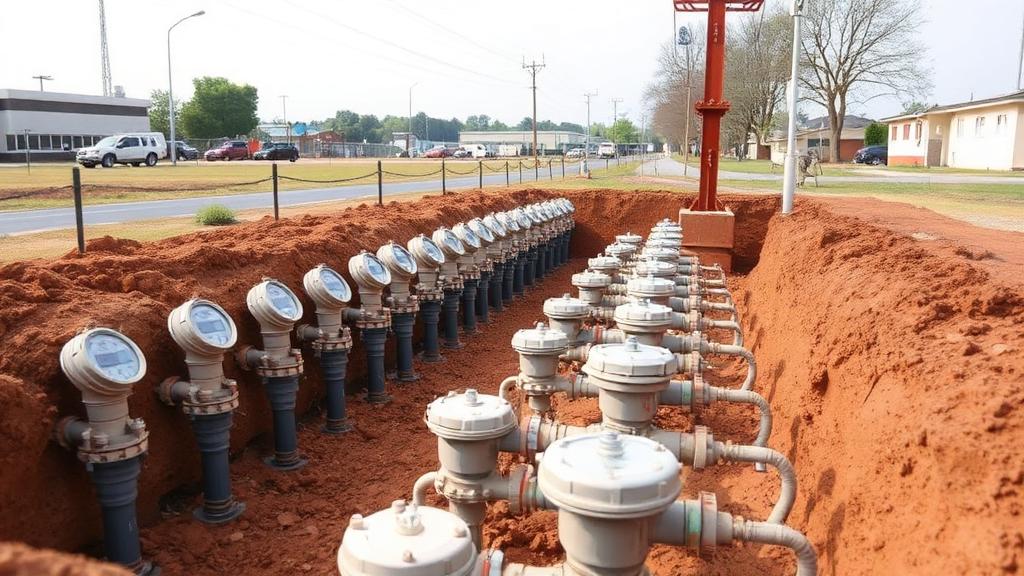
Accurate flow and pressure measurement at DMA boundaries is essential for effective loss management. Municipal providers benefit from working with instrumentation partners who understand the unique requirements of distribution system monitoring, including the need for battery-powered remote installations, wide flow range measurement, and robust communication in below-grade environments.
Leak Detection Technologies
Acoustic leak detection has evolved significantly with the advent of permanent acoustic monitoring systems. Unlike traditional leak surveys that provide a snapshot of system condition, permanent acoustic sensors listen continuously for the distinctive sound signatures of leaks. Correlating data from multiple sensors enables precise leak location, reducing the excavation area needed for repairs and minimizing disruption to customers and roadways.
Satellite-based leak detection uses synthetic aperture radar to identify ground moisture anomalies associated with underground leaks. While not as precise as acoustic methods for pinpointing individual leaks, satellite surveys can efficiently screen large service areas to prioritize acoustic surveys and direct repair crews to the highest-impact areas.
Transient pressure monitoring is an emerging technique that detects leaks by analyzing the reflection patterns of pressure waves traveling through the pipe network. This method can detect leaks in transmission mains and large-diameter pipes where acoustic methods may be less effective due to the lower frequency of leak noise.
Data Analytics and Decision Support
The volume of data generated by modern metering and monitoring systems requires sophisticated analytics to extract actionable intelligence. Water balance software platforms enable utilities to perform standardized water audits following the AWWA M36 methodology, quantifying both real and apparent losses and benchmarking performance against industry standards.
Predictive analytics use historical pipe break data, soil conditions, pipe materials, and age to forecast future failures and prioritize pipe replacement programs. By targeting the highest-risk segments for proactive replacement, utilities can prevent catastrophic breaks and the associated water loss, property damage, and service disruption.
Customer-side leak detection algorithms analyze AMI data to identify consumption patterns indicative of continuous leaks. Automated customer alerts can notify property owners of suspected leaks, enabling repairs before significant water waste occurs. Some utilities have reported that customer leak notification programs alone can reduce billed consumption by 5-10% while improving customer satisfaction.
Implementation Strategy for Municipal Providers
Municipal water providers considering NRW reduction programs should begin with a comprehensive water audit to establish baseline performance metrics. The AWWA Free Water Audit Software provides a standardized framework for this assessment and helps utilities prioritize interventions based on their specific loss profile.
A phased implementation approach typically begins with revenue meter testing and replacement, as apparent loss reduction provides immediate financial returns. DMA establishment and monitoring follow, enabling the utility to quantify and localize real losses. Targeted leak detection and repair campaigns address the highest-loss areas first, maximizing the return on investment.
Working with experienced instrumentation and metering partners like KW Metering ensures that the measurement foundation supporting NRW programs is accurate and reliable. From revenue meters to bulk flow measurement at DMA boundaries, precision instrumentation is the cornerstone of effective water loss management.
Conclusion
Non-revenue water represents both a significant challenge and a substantial opportunity for municipal water providers. The technologies and methodologies for NRW reduction are mature and proven, and the financial returns from well-executed programs consistently exceed investment costs. By combining advanced metering infrastructure, district metered area monitoring, leak detection, and data analytics, municipal providers can dramatically reduce water loss while improving operational efficiency and customer service. The key is starting with accurate measurement—because you can't manage what you can't measure.