Introduction
Municipal water providers are responsible for delivering safe, high-quality drinking water from the treatment plant to every customer's tap. While treatment plant operations receive significant attention and investment, water quality in the distribution system is equally critical and considerably more challenging to manage. The journey from treatment to tap can take hours or even days, during which physical, chemical, and biological processes can degrade the quality of fully treated water.
Distribution system water quality events—from discoloration complaints to boil-water advisories—erode public trust and can have significant health consequences. Proactive monitoring throughout the distribution network is essential for detecting quality changes before they affect customers. Modern instrumentation and analytics platforms, combined with accurate flow measurement from providers like KW Metering, enable municipal providers to maintain a real-time picture of water quality across their entire service area.
Key Water Quality Parameters
Chlorine residual is the primary indicator of microbiological safety in chlorinated distribution systems. Maintaining adequate residual throughout the network ensures ongoing disinfection as water travels from the treatment plant to customers. However, chlorine residual decays over time due to reactions with organic matter, pipe materials, and biofilm. Monitoring residual at strategic points throughout the distribution system enables utilities to verify that adequate disinfection is maintained and to adjust treatment plant dosing accordingly.
Turbidity monitoring in the distribution system can detect sediment disturbances caused by main breaks, valve operations, hydrant flushing, and changes in flow direction. While treatment plant effluent turbidity is typically well-controlled, distribution system turbidity can spike during operational changes, leading to discoloration complaints and potential health concerns if pathogen-harboring particles are released from pipe walls or sediment deposits.
pH affects chlorine disinfection efficacy, corrosion control, and customer perception of water quality. Distribution system pH can change due to cement-morite pipe interactions, blending of water from different sources, and seasonal variations in source water chemistry. Monitoring pH at key points helps utilities maintain optimal corrosion control and disinfection performance.
Strategic Monitoring Locations
The selection of monitoring locations is critical to the effectiveness of a distribution system water quality program. Monitoring stations should be located to capture the range of water ages, source water blends, and hydraulic conditions present in the system. Key location types include:
Treatment plant effluent monitoring establishes the baseline quality entering the distribution system. Entry point monitoring at interconnections with other utilities captures the quality of imported water. Storage facility inlet and outlet monitoring tracks quality changes during storage. Dead-end and low-flow area monitoring captures worst-case conditions where water age is highest and residual depletion is most severe.
Flow measurement plays a crucial role in water quality management by enabling utilities to calculate water age, identify stagnation zones, and understand how hydraulic conditions affect quality. Accurate flow data from KW Metering instruments at key network nodes enables hydraulic modeling that predicts water quality throughout the system, not just at monitoring points.
Online Analyzers vs. Grab Sampling
Traditional water quality monitoring relied heavily on grab sampling—collecting water samples at specific locations and transporting them to a laboratory for analysis. While grab sampling provides accurate analytical results, it captures only a snapshot of conditions at the moment of collection. Water quality events that occur between sampling visits may go undetected until customer complaints arrive.
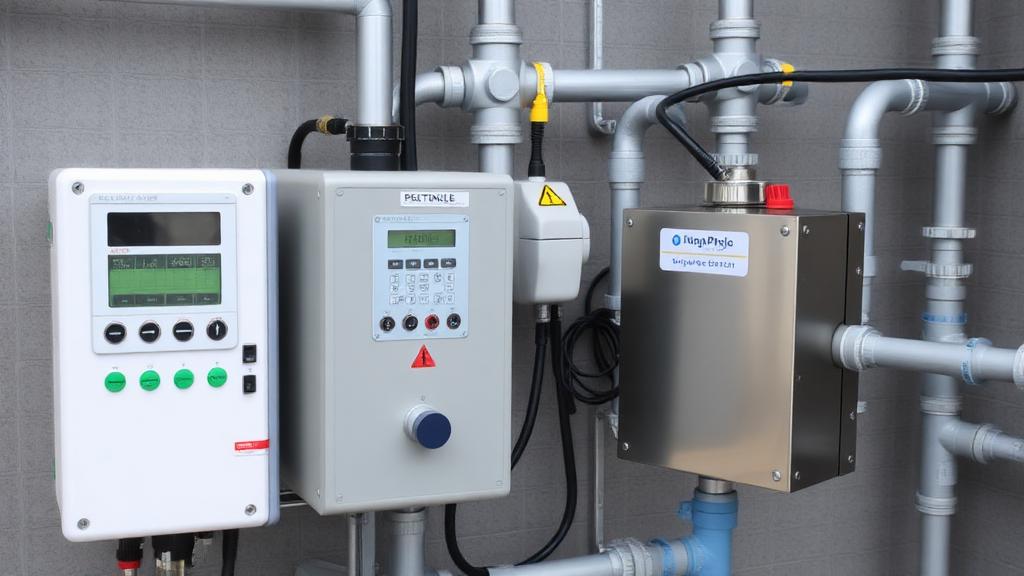
Online water quality analyzers provide continuous monitoring at fixed locations, generating data at intervals of minutes rather than days or weeks. Modern analyzers for chlorine residual, turbidity, pH, and conductivity are reliable enough for unattended operation at remote monitoring stations. Multi-parameter monitoring stations that combine several analyzers with flow measurement provide comprehensive water quality surveillance at critical network locations.
The cost of online monitoring has decreased significantly, making it practical for municipal providers to deploy monitoring stations throughout their distribution networks. Cloud-connected analyzers can transmit data to central SCADA systems and mobile devices, enabling operators to monitor system-wide water quality from anywhere. Automated alarms alert operators to quality excursions that require immediate response.
Flushing Program Optimization
Systematic flushing programs are essential for maintaining water quality in distribution systems, but conventional calendar-based flushing wastes significant volumes of treated water. Data-driven flushing uses continuous water quality monitoring to identify when and where flushing is actually needed, reducing water waste while improving effectiveness.
Directional flushing programs use hydraulic modeling to design flushing sequences that move water through the system in a controlled manner, progressively cleaning pipes from the source outward. Flow measurement at hydrants and flushing points enables operators to verify that target velocities are achieved for effective sediment removal.
Monitoring turbidity during flushing operations enables operators to determine when flushing has achieved its objective, avoiding both insufficient flushing that leaves sediment in place and excessive flushing that wastes water and disrupts service. Real-time turbidity monitoring at the discharge point transforms flushing from a time-based activity to a results-based one.
Emerging Contaminant Monitoring
Municipal water providers face growing pressure to monitor for emerging contaminants including per- and polyfluoroalkyl substances (PFAS), pharmaceutical residues, and microplastics. While routine monitoring for these contaminants currently requires laboratory analysis, online screening technologies are rapidly advancing.
Total organic carbon (TOC) monitoring provides a general indicator of organic contamination that can serve as an early warning of source water quality changes. UV absorbance at 254nm correlates with dissolved organic compounds and can indicate the potential for disinfection byproduct formation. These surrogate parameters are practical for continuous online monitoring and provide valuable trending data between laboratory sampling events.
Fluorescence-based sensors can detect certain classes of organic contaminants in real-time, offering potential for early warning of contamination events. While not yet suitable for regulatory compliance monitoring, these sensors add a layer of security to distribution system monitoring programs.
Data Management and Response Protocols
Effective water quality monitoring generates large volumes of data that must be managed, analyzed, and acted upon. Data management platforms that integrate water quality data with operational data—including flow rates, tank levels, pump operations, and valve positions—enable operators to understand the hydraulic context of water quality observations.
Standard operating procedures for water quality responses should define clear action levels and response protocols for each monitored parameter. Tiered response frameworks escalate actions from investigation to operational adjustment to public notification based on the severity and duration of quality excursions. Regular drills and exercises ensure that operators are prepared to execute response protocols effectively.
Conclusion
Maintaining water quality throughout municipal distribution systems requires a strategic approach to monitoring that combines online analyzers at critical locations, accurate flow measurement for hydraulic understanding, and data analytics for pattern recognition and predictive management. Municipal providers that invest in comprehensive distribution system monitoring protect public health, maintain customer trust, and optimize their operations. With instrumentation partners like KW Metering providing the flow measurement foundation, utilities can build monitoring programs that deliver real-time visibility into water quality across their entire service area.